So the inventor’s limited time goes to what you most want to ask.
We design and build an AI dedicated to your practice, tailored to how you work, that helps turn the inventor’s materials into interview questions. Judgement on rights stays with the patent attorney.
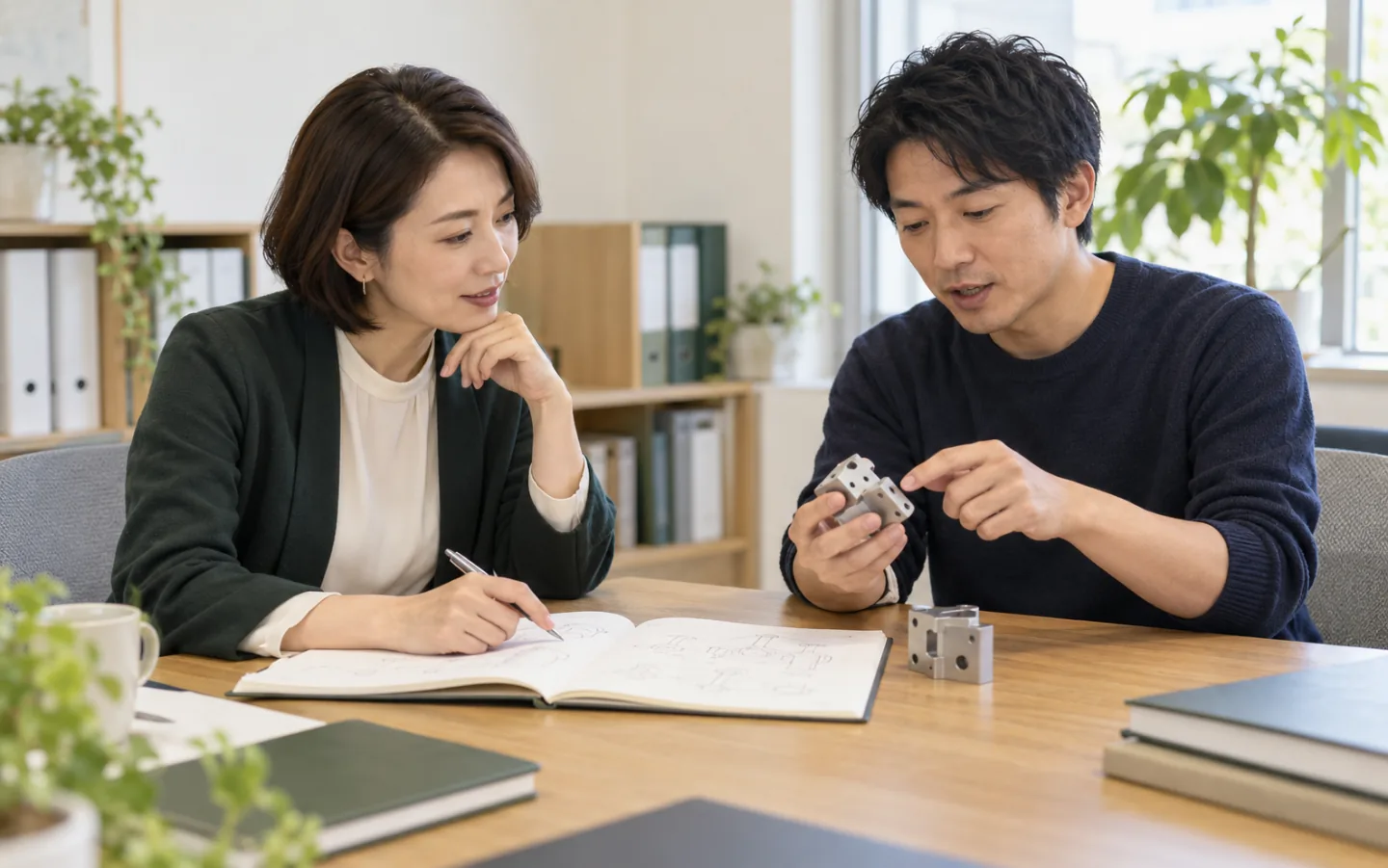
AI-generated image of a work scene. Not a real customer or case study. The prototype in the photograph is fictional and does not indicate that a patent can be obtained or that novelty has been judged.
The material is in the language of engineers, and what can be asked in a meeting is limited
An inventor’s explanatory material is written in an engineer’s words. What is different from the prior art, and what supports the effect? Meeting time is limited, and anything left unasked has to be confirmed later through repeated exchanges.
A FICTIONAL EXAMPLE
What it could look like (a fictional example)
A fictional example. The invention, the wording of the material and the page numbers do not exist.
Preparation sheet before a meeting (a fictional invention: a locking mechanism for a folding cart)
Preparation sheet before a meeting (a fictional invention: a locking mechanism for a folding cart)
What the material says (fictional extract)
Source
Draft question
Viewpoint
What the material says (fictional extract)‘Easier to operate with one hand than the earlier locking method’
SourceExplanatory material, slide 3
Draft questionWhat was the earlier locking method it was compared with? Please walk through how it is operated with one hand.
ViewpointDifference from the prior art
What the material says (fictional extract)‘The locking strength has improved’
SourceExplanatory material, slide 5
Draft questionHow was the strength measured? The conditions of comparison (load, number of cycles) are not found in the material.
ViewpointEffect
What the material says (fictional extract)‘The shape of the claw is as in figure 2’
SourceExplanatory material, slide 4, figure 2
Draft questionWould the same effect appear if the number or shape of claws changed? Were any variations tried?
ViewpointEmbodiment
What the material says (fictional extract)(Nothing found in the material)
Source—
Draft questionHas it been shown, presented or provided outside the company on any occasion so far?
ViewpointOther confirmation (disclosure status)
‘Draft questions’ are drafts that the patent attorney chooses and edits. They include no assessment of patentability or scope of rights. A row with an empty source is a question to confirm something the material does not say.
HOW THE WORK GOES
How the work goes: what the AI helps with, and what the patent attorney decides
What LLL does: build private AI to help prepare questions from invention materials
We design support, with a private LLM that only the person on the matter can see and that sends nothing outside, for drafting what to ask from the explanatory material. The setup and the quality of the draft questions are checked in the evaluation.
The steps below are a design proposal. The AI prepares drafts and lists only; people check and decide.
1
Put the explanatory material where only the person on the matter can see it
An unfiled invention is loaded into a range that only the patent attorney on it (and an assistant on it) can see. On the premise that nothing is sent outside, where its traffic goes is actually checked.
Prepared by the AI
A workspace visible only to the person in charge, and the result of the connection check
Checked and decided by people
The scope loaded and the connection destinations
LLL’s proposal
2
Read the material and organise it under three viewpoints
For differences from the prior art, effects and embodiments (variations and alternatives), what the material says (and where) is separated from what it does not say.
Prepared by the AI
A draft organised under three viewpoints (what is written / not written)
Checked and decided by people
Checking the draft against the briefing material
LLL’s proposal
3
Draft what to ask
From what the material says and leaves unsaid, draft questions, each with where in the material it came from. It does not offer a question that treats something the material does not say as if it did.
Prepared by the AI
Sourced draft questions
Checked and decided by people
Choosing the questions and wording them
LLL’s proposal
4
The patent attorney chooses, edits, and uses them in the meeting
Which questions to keep and their wording are the attorney’s decision. Any answer touching a deadline always carries ‘confirm the deadline in the deadline table’.
Prepared by the AI
A “check deadlines in the control table” note added to chosen questions
Checked and decided by people
Checking deadlines in the control table, and how to use the questions in the meeting
LLL’s proposal
5
Judgement on rights stays with the patent attorney
Patentability, the design of the scope of rights and the decision to file are not part of this. The attorney decides them in light of the meeting.
Prepared by the AI
(Nothing is prepared by the AI in this step)
Checked and decided by people
Judging patentability, claim scope and filing
LLL’s proposal
What we want to give back: time spent listening deeply to the inventor
The aim is to lighten the work of re-reading the material to pick out questions, so the meeting can concentrate on listening deeply to the inventor.
How much effort this saves, and how good the questions are, will not be stated until measured on actual material. We do not show track-record figures.
DOCUMENTS
The documents, and how each is loaded
List of documents
Document
Role in the work
How it is loaded
DocumentThe inventor’s explanatory material (proposal, slides, reports)
Role in the workThe source of the draft questions
How it is loadedLoaded (only the person on the matter)
DocumentExperimental data, drawings, photographs of a prototype
Role in the workChecking effects and embodiments
How it is loadedHow much to load is discussed. Text inside figures and handwriting can be read only to a limited extent
Role in the workThe standard for what to ask about
How it is loadedLoaded (shared across the firm)
DocumentPast exchanges with the inventor
Role in the workA follow-up meeting on the same invention
How it is loadedLoaded (only the person on the matter)
DocumentThe deadline table
Role in the work—
How it is loadedNot loaded (a person checks it in the existing system)
DocumentPast specifications and responses, and prior-art literature
Role in the work— (outside this page)
How it is loadedNot loaded at first
Searching past specifications and responses is a different job from this page. This page is limited to preparing what to ask from the inventor’s explanatory material.
HOW WE CHECKWhat we check in the PoC
What we check in the PoC
The passing lines and the number of cases are decided in consultation. No figures have been measured for the items below. The evaluation first uses pseudo explanatory material made from already-published subjects.
What the PoC checks
What is checked
How it is checked
Expected state
Passing line
Measured
What is checkedWhether an unfiled matter appears in the search of someone not on it
How it is checkedAs a person not on the matter, run questions asking for the invention’s content or name, and check that nothing appears in answers or sources.
Expected stateAn unfiled matter appears for nobody except those on it.
Passing lineDecided in consultation
Measurednot measured
What is checkedWhether an answer touching a deadline always carries ‘confirm the deadline in the deadline table’
How it is checkedMix deadline-related questions into the evaluation set and have a person check how every answer is displayed.
Expected stateA setting that omits it is not allowed.
Passing lineDecided in consultation
Measurednot measured
What is checkedWhether a draft question opens to the place in the material it came from
How it is checkedFor every draft question, open the source and have a person check that it matches the relevant part of the material.
Expected stateA draft whose source does not open is distinguished as a question to confirm something the material does not say.
Passing lineDecided in consultation
Measurednot measured
What is checkedWhether it asks about something the material does not say as if it did
How it is checkedCheck the premise of each draft question, one by one, against what the material says.
Expected stateErrors in premises are counted and recorded.
Passing lineDecided in consultation
Measurednot measured
What is checkedQuestions missed, and questions in excess
How it is checkedCompare the AI’s drafts with a list of questions the attorney drew up first, and count misses and unnecessary ones.
Expected stateThe numbers are recorded. The tolerance is decided in consultation.
Passing lineDecided in consultation
Measurednot measured
What is checkedWhether anything leaves the system
How it is checkedAfter the build, check actual traffic records.
Expected stateNo unexpected destinations.
Passing lineDecided in consultation
Measurednot measured
How to check against the originals
How to check against the originals
From the ‘source’ of each draft question you can open the relevant part of the explanatory material. The AI’s draft is a way back into the material; the words used in the meeting and the judgement on rights are the attorney’s.
Open the draft question’s ‘source’
Compare the material’s wording with the premise of the question
Treat a draft question with an empty source as asking about something the material does not say
Record any discrepancy as a ‘correction’
Designing what each person can see
Designing what each person can see
Who can see what
Who
Can see
Cannot see
WhoThe patent attorney on the matter and an assistant on it
Can seeThe explanatory material and draft questions for the unfiled matters they handle
Cannot seeMatters they are not on
WhoOther staff in the firm
Can seeThe firm’s shared question template
Cannot seeUnfiled matters (outside their own)
WhoThe inventor and the client company’s staff
Can seeNot used in the initial setup (the attorney only)
Cannot see—
For unfiled inventions, what can be seen is designed as narrowly as possible. If a client company restricts putting its information into AI, agreement is obtained whether or not the information is used for training, as the guideline says.
FIT
When it fits, and when it does not
When it fits
Firms that read the explanatory material and organise what to ask before meeting an inventor
Firms that can clearly decide, as a firm, who handles unfiled matters and in what range
Firms comfortable with first checking how it works on pseudo material made from already-published subjects
When it does not fit
If you expect the AI to assess patentability, draft claims or search the prior art
If you want the AI to manage deadlines
If you want to put unfiled inventions as they are into an external AI service (outside this page)
FIRST DECISIONS
What the firm decides first
Which kind of matter to start with (patent / trademark / both)
Who may handle unfiled matters
Which question template to use
How to obtain the client company’s agreement
The subject of the pseudo material for the evaluation
Whether to include a PoC (optional)
After you start using it
We check together how the draft questions are used, the drafts whose sources would not open and the questions that were missed, and adjust the question template and what is loaded. The scope and fee of continuing support are agreed before we start.
Included
Checking how the drafts are used and updating the question template
Reviewing what is loaded and what each person can see
Re-running the evaluation questions
Not included
Promises of results or sales
Open-ended unpaid support
Judging patentability or scope of rights, and managing deadlines
The scope and fee of continuing support are agreed before we start. We do not promise sales or result figures, or open-ended unpaid support.
GOOD TO KNOW FIRST
Good to know first
Assessing patentability and scope of rights, deciding to file and managing deadlines stay with the patent attorney. The association’s guideline sets out points to watch and does not say an in-house AI resolves the concerns. No measured effect is shown.
The full scope, from server selection to operations, is on the PrivateLLM deployment, build and operations page.
Conversations are recorded.Read the privacy policyPlease do not write the technical content of unfiled inventions.
QUESTIONS
Frequently asked questions
Does drafting questions mean the AI is judging whether something will be patentable?+
No. The drafts come from what the material says and leaves unsaid. Assessing patentability or scope of rights and drafting claims are not part of this page. Choosing and editing what to ask is the patent attorney’s.
Does the Japan Patent Attorneys Association’s guideline say an in-house AI is fine?+
No. The guideline sets out points to watch, such as that putting information on a third-party service without a confidentiality agreement may destroy novelty; it does not say an in-house AI resolves them. This page premises that nothing is sent outside and checks it by measuring actual traffic. Whether something counts as disclosure is for the patent attorney to judge.
Can it read drawings, experimental graphs and handwritten notes?+
Text inside figures and handwriting can be read only to a limited extent. A figure it cannot read is shown as ‘a person checks the figure’. How far it can read is checked in the evaluation.
Can inventors use it directly?+
In the initial setup, only the patent attorney uses it. A version for inventors needs a different design of what can be seen and how secrets are handled, so it is discussed separately.
Can it manage deadlines too?+
No. Deadlines are checked by people in the existing deadline table. Any answer touching a deadline carries ‘confirm the deadline in the deadline table’, and the AI’s output is never the basis for a deadline.
What if the client company restricts putting its information into AI?+
The guideline says that when the client’s confidential information is put into AI, the client’s agreement should be obtained whether or not it is used for training. How to obtain it is the firm’s decision. LLL can help put on one page where documents are stored, who can see them and where traffic goes.
Are past specifications and responses used?+
Not in the initial setup. Searching them is a different job, covered on the entrance page for patent attorneys. This page is limited to preparing questions from the inventor’s explanatory material.
Where can I start? Is the PoC required?+
The PoC is not required. You can start from server selection or setup advice, the 30-day PoC, or a production rollout and operations. "Private LLM PoC" is US$3,000 (teams of up to 50) / US$6,000 (51 or more) and is evaluated on LLL's existing infrastructure within the agreed scope.
Can you also run and maintain it after deployment?+
Roles for updates, monitoring, incident contact, backup and recovery are decided at deployment and handed over. The PoC price does not include production operation and maintenance. If you want us to keep running it, the scope is defined and quoted in advance.
How long does it take and what does it cost?+
The PoC takes 30 days, and "Private LLM PoC" is US$3,000 (teams of up to 50) / US$6,000 (51 or more). For production, lead time and cost depend on the number of users, the volume and condition of documents, where it is installed and the scope of integration and operations, so they are quoted in advance.
This opens the AI chat on the LLL website. Conversations are recorded.Read the privacy policyPlease do not write the technical content of unfiled inventions.
SOURCES
What this page draws on, and what the source does not show
Preparing what to ask from explanatory material, loading it into a range only the person on the matter can see, and the evaluation items are LLL’s proposal. They are not what the guideline says.
The attorney checks the output and bears responsibility; entering information into a third-party service without a confidentiality agreement may destroy novelty; the client’s confidential information needs the client’s agreement whether or not it is used for training.
That the attorney checks AI output and bears responsibility (chapters 1 and 5); that putting information on a third-party platform without a confidentiality agreement may destroy novelty (chapter 4); that the client’s confidential information needs the client’s agreement whether or not it is used for training (chapter 4). PDF pp. 1, 7, 8, 9
What it does not show
Any view that an in-house AI resolves these concerns, or filing procedures.
Care taken on this page
It is the association’s guideline setting out points to watch when patent attorneys use AI. It is not a law that newly imposes duties on attorneys.
It does not say that an in-house AI resolves these concerns.
It does not describe using AI to prepare questions from an inventor’s explanatory material, or filing procedures.
‘May destroy novelty’ is the guideline’s wording. This page does not judge whether something counts as disclosure.
PRICE
Prices that may be the starting point for this work
Which one fits is chosen after the scope is set in consultation. The PoC is not required.
One-time
Private LLM PoC
US$3,000 (teams of up to 50) / US$6,000 (51 or more)
A 30-day test of a private LLM on your own documents and workload.
Included
30-day PoC (same as the official menu)
Includes evaluation on LLL's existing infrastructure within the agreed PoC scope
Testing on your own documents and workload
If you continue with the next step, we deduct this fee in full from that invoice. No expiry.
Not included
Customer hardware purchases, production hosting, and cloud or API use outside the agreed PoC scope (quoted separately)
Prices in USD. Taxes, payment/FX fees and third-party service, hardware, cloud and API costs are extra. Work beyond the stated scope or hours is quoted before it starts and done only after your approval.
NEXT STEP
The next step
You can ask a question first, or shape a message and send it. In either case you do not need to write the firm’s name or the content of any invention.
This opens the AI chat on the LLL website. Conversations are recorded.Read the privacy policyPlease do not write the technical content of unfiled inventions.
Copy it into the contact form and rewrite it freely. Please do not write anything that identifies a client or a firm.
[Patent attorneys: preparing what to ask from an inventor’s explanatory material]
Size of the firm (number of patent attorneys):
Form of the explanatory material (proposal / slides / report, etc.):
How unfiled matters are managed today:
What concerns you:
(Edit this freely before sending. Please do not include the content of unpublished inventions.)
These scenes follow the qualification systems of Japan. They are not treated as the same as similarly named qualifications in other countries. Laws, standards and forms are revised, so the final check is made by each qualified professional.