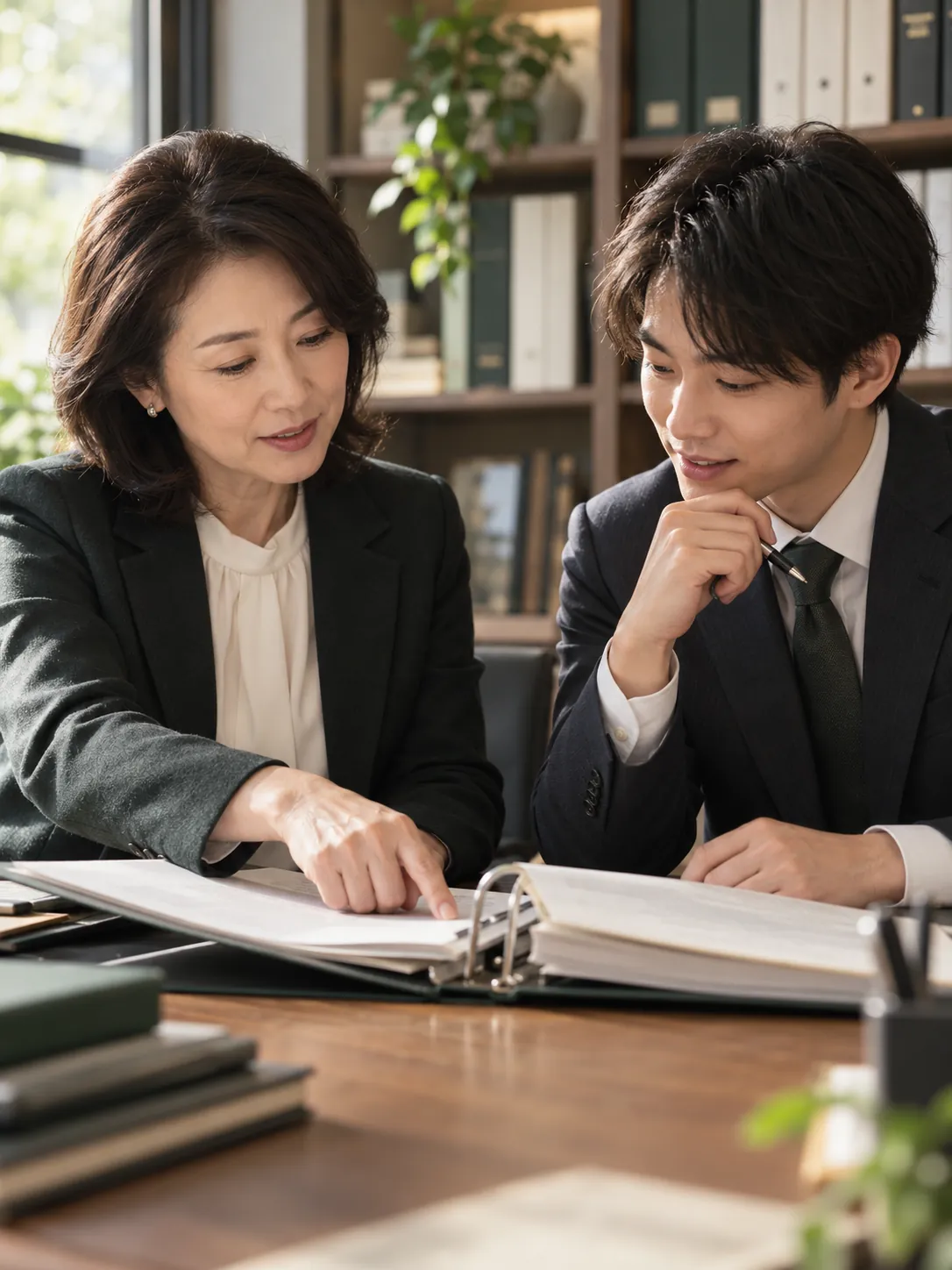
AI-generated image of a work scene. Not a real customer or case study.
PRIVATE LLM / PROFESSIONAL SERVICES
PrivateLLM deployment, build and operations for professional services
While keeping what each matter shows within its own range, draw on what past matters taught you, only by people with permission, without sending client documents outside. Together we build an in-house AI that answers with sources, fitted to the work of lawyers, judicial scriveners, administrative scriveners, tax accountants, public accountants (CPA) and patent attorneys.
In the first talk we sort out the first task and its documents. An evaluation (PoC) is optional, and scope and fees are agreed beforehand.
SIX PROFESSIONS
A day in the work of six professions
These scenes follow the qualification systems of Japan. They are not treated as the same as similarly named qualifications in other countries. Laws, standards and forms are revised, so the final check is made by each qualified professional.
This judgement is the qualified professional’s own. The AI goes only as far as finding and showing the grounds.
01
Lawyers
A sceneTakes over a departed colleague’s matter and looks for how similar past disputes were argued.
What the AI helps withDrafts a timeline from the matter’s documents and offers wording from past briefs, with the source shown.
Final professional judgementBuilding the argument, weighing evidence, advising the client and signing stay with the lawyer.
Open the full scene, documents, checks and sourcesClose the full scene, documents, checks and sources+
Who
A junior lawyer taking over a matter, and the partner who reviews it.
A scene
After a colleague leaves, the lawyer takes over a matter and looks for how the firm built its argument in a similar contract dispute, without the name or content of another client in a conflicting position appearing in the answer.
Drafts a timeline from the matter’s own documents; offers wording from past briefs with its source; says “not found” when it cannot find one. It suits first-pass research and checking differences from a template. For a complex contract, a person revising an earlier template can be faster, so that part is not left to the AI.
Final professional judgement
Building the argument, weighing evidence, advising the client and signing the document stay with the lawyer.
What we check
No client name or content crosses matters (same question, different permissions).
The shown source opens and matches the original.
What the document says A contribution in the Tokyo Bar Association’s bulletin (July–August 2026) says generative AI can help with a first look at a topic and with comparing the other side’s draft against a standard contract template, while for complex non-standard contracts it is often faster for the lawyer to edit an earlier template by hand. The same bulletin reports that the association’s guidelines ask lawyers who enter highly confidential information to explain that use to the client and, where necessary, obtain consent. The author of that guidelines article adds that even an on-premises setup may communicate externally depending on configuration and operation. Source1
What the document says The Japan Federation of Bar Associations’ statement (1 September 2026) says people must make the final judgment. Source2
LLL’s proposal (not something the documents say) Preparation and difference-checking are what we support; judgment on complex contracts and the final text stay with people. After the build, we check actual traffic for anything leaving the system.
A common question for this profession Can the AI check conflicts of interest? A lawyer decides on conflicts. The AI only searches within each matter’s visible range and does not stand in for that judgement.
02
Judicial scriveners
A sceneThe day before settlement, compares the attachments received with a past case of the same type to find gaps.
What the AI helps withDrafts an attachment checklist and shows the steps of similar cases. Sensitive items are separated first.
Final professional judgementIdentity verification, whether the application is right, and filing it stay with the scrivener.
Open the full scene, documents, checks and sourcesClose the full scene, documents, checks and sources+
Who
A judicial scrivener handling registrations, and an assistant.
A scene
The day before a property sale settles, they compare identity-check records, the documents behind the registration, and the receipt of attachments against the steps of a past case of the same type, looking for gaps.
Drafts a checklist of attachments and shows the steps of similar past cases. Highly sensitive items such as registration identifiers are separated first, deciding what the AI may hold. It stops at organising the documents received, the requests and the course of events; it does not obtain records such as family registers or stand in for any legal authority.
Final professional judgement
Identity verification, whether the application is right, and filing it stay with the scrivener.
What we check
The “not loaded” range really keeps those items out of search.
The source of each list item (which past document) opens.
What the document says In the White Paper 2025, the summary of open-ended answers on problems in inheritance and wills work (458 replies) shows the most frequent requests concern online and wider-area access to family registers and authority to represent clients in family-court matters. It also quotes, as examples, the view that surrounding tasks are laborious relative to the fee that can be charged, that municipal counters coordinate poorly, and unease about how far one can take part in estate-division talks without crossing professional boundaries. Shares by theme are charted, but the denominator and how a reply touching several themes was counted are not stated, and the number of people behind each quoted view is not given. Source3
LLL’s proposal (not something the documents say) We limit it to organising the documents received, the matters requested and the course of events. We do not stand in for obtaining family registers or authority, nor judge professional boundaries.
A common question for this profession Is it safe to let the AI read registration documents? We first decide what is loaded and what is not. What is not loaded is never searched. Even within what is loaded, the scrivener makes the final check.
03
Administrative scriveners
A sceneAt a construction-licence renewal, compares what the revised form asks with the wording of past applications.
What the AI helps withSummarises past correction requests and drafts an attachment checklist, with the guidance version and date added.
Final professional judgementWhether the application is right, filing with the authority and explaining to the client stay with the scrivener.
Open the full scene, documents, checks and sourcesClose the full scene, documents, checks and sources+
Who
An administrative scrivener who handles permit applications.
A scene
A construction-licence renewal. The authority’s forms and guidance have been revised, and the scrivener wants to compare the wording and attachments of past applications with what the new form asks.
Documents
Application copies, client-supplied materials, the authority’s guidance, records of requested corrections.
What the AI helps with
Summarises the pattern of past correction requests; drafts an attachment checklist; adds the guidance version and retrieval date to the answer.
Final professional judgement
Whether the application is right, filing with the authority, and explaining to the client stay with the scrivener.
What we check
When guidance is revised, old versions do not linger in answers.
One client’s documents do not mix with another’s.
LLL’s design No public source is cited for this profession here. What follows is LLL’s own evaluation design, not a statement drawn from any document. On the premise that the documents needed differ by type of application, we separate the material by type and check that revised and old forms are not confused. LLL’s role stops at helping to compare documents; whether an application is acceptable is for the administrative scrivener to judge.
A common question for this profession What happens when a form changes? We aim to attach the guidance version and retrieval date to answers, and check with you at each revision that old versions do not remain. The scrivener confirms the latest form.
04
Tax accountants
A sceneBefore a closing month, searches each client’s meeting notes and past return copies for how a point was handled last time.
What the AI helps withShows where the earlier handling came from and drafts confirmation notes. What each client’s file shows is kept apart.
Final professional judgementTax judgements and signing the return stay with the tax accountant, who also checks the latest laws and notices.
Open the full scene, documents, checks and sourcesClose the full scene, documents, checks and sources+
Who
A tax accountant handling monthly advisory and year-end closing for small firms, and a staff member.
A scene
Before a closing month, they search each client’s meeting notes and past return copies for how a point was handled last time.
Documents
Return copies, accounting data extracts, client meeting notes, past questions and answers.
What the AI helps with
Shows where the earlier handling came from; drafts confirmation notes; separates what each client’s file shows.
Final professional judgement
Tax judgements and signing the return stay with the tax accountant. Laws and notices are amended, so the latest is checked by the accountant; the AI’s answer is not promised to be the current interpretation.
What we check
Nothing crosses between clients.
The date of the past handling is attached, so an old handling is less likely mistaken for a current one.
LLL’s design No public source is cited for this profession here. What follows is LLL’s own evaluation design, not a statement drawn from any document. We begin by comparing each client’s prior-year and current-year material while keeping what each person can see separate. LLL’s role stops at helping to compare documents; judgment on filings stays with the tax accountant.
A common question for this profession Will the AI keep up with tax-law changes? We cannot promise that. We aim to attach the date of the source document, and the tax accountant confirms the latest.
05
Public accountants (CPA)
A sceneIn an interim audit, compares last year’s working papers with this year’s changes to find any point not yet covered.
What the AI helps withShows the relevant part of last year’s papers and drafts a list of points. What each audited company’s file shows is kept apart.
Final professional judgementAudit judgement, forming the opinion and approving the papers stay with the CPA.
Open the full scene, documents, checks and sourcesClose the full scene, documents, checks and sources+
Who
An audit team manager and a junior accountant.
A scene
An interim audit. They compare last year’s working papers with this year’s changes and look for any point not yet covered.
Documents
Prior-year working papers, procedure guides, lists of received materials, records of findings.
What the AI helps with
Shows the relevant part of last year’s papers; drafts a list of points; separates what each audited company’s file shows. This is a search of the firm’s own standards and manuals, a different job from a tax accountant’s filing documents.
Final professional judgement
Audit judgement, forming the opinion and approving the papers stay with the CPA. How independence and quality-control rules are applied is decided by the firm.
What we check
Papers do not cross between audited companies.
The shown part is that version of the original.
What the document says The 2025 report of the Certified Public Accountants and Auditing Oversight Board records that large audit firms are introducing generative AI for queries over internal rules and audit manuals. It also records that, across the audit industry, tools that assist auditors with summarising, translating and proofreading are being introduced or considered, and that the issues noted for generative AI are the difficulty of ensuring explainability of how an output is produced and hallucination (wrong outputs). Source4
LLL’s proposal (not something the documents say) We limit it to searching a firm’s internal standards and manuals, with the passage and version attached to each answer. Which standard, which version and which original is shown in a form a person can verify. Audit judgment stays with the accountant, not the AI.
A common question for this profession Can the AI take over audit judgement? No. The AI only finds and shows the relevant part of the prior record. Judgement and opinion stay with the CPA.
06
Patent attorneys
A sceneBefore meeting the inventor, looks for how similar past applications were written and how office actions were answered.
What the AI helps withOrganises the points of past responses and drafts interview questions. Unfiled inventions get the narrowest visible range.
Final professional judgementScope of rights, the decision to file, and managing and meeting deadlines stay with the attorney; people check deadlines in the table.
Open the full scene, documents, checks and sourcesClose the full scene, documents, checks and sources+
Who
A patent attorney handling patent and trademark filings, and the engineer who is the inventor.
A scene
Before meeting the inventor, the attorney looks for how similar past applications were written and how office actions were answered, and wants a draft of what to ask.
Documents
Specifications, office action notices, responses, deadline tables, inventor interview records.
What the AI helps with
Organises the points of past responses; drafts interview questions. Unpublished inventions are secret, so the visible range is designed as narrow as possible. The original text and the final check stay with the patent attorney, who opens the original to confirm any AI output.
Final professional judgement
Designing the scope of rights, deciding to file, and managing and meeting deadlines stay with the attorney. Deadlines are checked by people in the existing system, and the AI’s output is never the basis for a deadline.
What we check
A not-yet-filed matter does not appear in anyone else’s search.
Any answer about deadlines says to confirm in the deadline table (a setting that omits this is not allowed).
What the document says The Japan Patent Attorneys Association’s guideline (April 2025) says the attorney checks AI output and bears responsibility, that entering information into a third-party service without a confidentiality agreement may destroy novelty, and that the client’s confidential information needs the client’s agreement whether or not it is used for training. Source5
LLL’s proposal (not something the documents say) For material on unpublished inventions, we decide who may see it and which original governs first, and check where traffic goes. Answers lead back to the passage in the original and are used to prepare for discussion with the inventor. Final checking and responsibility stay with the patent attorney.
A common question for this profession If an unfiled invention goes into the AI, could it count as disclosed? We split the loaded range as narrowly as possible and design on the premise that nothing is sent outside. Whether something counts as disclosure is the attorney’s judgement.
In the first sorting-out we put on one page which profession to start with, where the “not loaded” line is, and who makes the final check. A firm with several professions draws a separate line for each, because the sensitivity of the documents differs even within one firm.
AN ASSUMED SCENE
A scene: the partner opens the source and checks it
A staff member asks about similar past matters. The answer comes with sources, drawn only from matters they work on. The partner opens the cited source and checks the relevant part of the original.
An assumed scene. Not a real customer or case study.
WHY IT FEELS SAFE TO START
Three ways to start with confidence
It fits the work
Ask and open the source within your usual matter folders. Time spent searching becomes time spent thinking.
Try the same question under different permissions and see whether someone without access can draw out another matter’s content.
Showing sources
See whether each claim in an answer points to a part of the original that can be opened and checked.
Permission changes
See whether adding, removing or departing staff is reflected in search results afterwards.
Handling records
If client information remains in question-and-answer logs, decide where they are kept, who can see them and for how long.
When nothing is found
See whether it says it does not know when there is no source, instead of filling the gap with a guess.
No figures are shown here. The method and the pass criteria are set around your documents and work, and the results are recorded.
HOW THE WORK CHANGES
The flow of work we expect after deployment
01
The AI searches within each matter’s own permissions.
02
Answers are meant to carry the relevant part of the original.
03
Professionals open the source, check it and correct it if needed.
04
On the day staffing changes, we confirm that permissions took effect.
This is the intended way of working. How far it goes is checked with your real documents within the agreed scope.
FROM THE FIRST TALK TO PRODUCTION
We go from first talk to production in separate stages
Consultation
First, sorting it out
We hear about the work, documents, number of users and site conditions, and return a proposed way forward. What can be sorted out here is the first single task, the documents and where they sit, the information classes that cannot leave, and the items to check in an evaluation. Evaluation results themselves do not come out at this stage.
People who help the first talk move fasterA partner or the head of the firm, the person responsible for matter or information management, and the person in charge of information systems.
30-day PoC
Then, an agreed evaluation
The checks above are tried for real within the agreed scope. What you receive is a record of the expected and actual result for each item, the points to fix and what cannot be covered, and the material to decide the scope of build and operations.
Fees start at this stage. The scope and the amount are on the price card below.
Build and operations
Finally, the decision on production
Based on the record, we define the scope of build and operations and the quote conditions, and you choose whether to go ahead, narrow the scope or stop. Even if you stop, the record is yours.
AFTER THE BUILD
The path for this kind of work
We do not hand over a server and leave. We help grow how it is used, toward the goal you set.
1
Set the goal
Pick one matter type and decide how you want searching and checking effort to change.
2
Build it into the work
Place it within the matter folders and permissions as they are.
3
Measure the effect and record it
Try the same question by permission and record whether sources open.
4
Keep improving
Recheck reflection at each revision of forms or templates.
5
Widen the use
Choose whether to move to the next matter type or profession’s documents.
The scope and fee of continuing support are agreed before we start. We do not promise sales or result figures, or open-ended unpaid support.
GOOD TO KNOW FIRST
What to know first in this industry
We do not judge compliance with confidentiality duties or professional laws. That is for the professionals and competent authorities.
AI answers are not a substitute for professional judgment. People make the final check.
Obtaining third-party certification and acting as an auditor are not included.
PrivateLLM alone does not make a leak impossible. In addition to where inference runs, we also evaluate the following paths.
The full scope, from server selection to operations, is on the PrivateLLM deployment, build and operations page.
Conversations are recorded.Read the privacy policyPlease do not write client information or matter details.
PRICE
Pricing for this service
One-time
Private LLM PoC
US$3,000 (teams of up to 50) / US$6,000 (51 or more)
A 30-day test of a private LLM on your own documents and workload.
Included
30-day PoC (same as the official menu)
Includes evaluation on LLL's existing infrastructure within the agreed PoC scope
Testing on your own documents and workload
If you continue with the next step, we deduct this fee in full from that invoice. No expiry.
Not included
Customer hardware purchases, production hosting, and cloud or API use outside the agreed PoC scope (quoted separately)
Production operation and maintenance
Prices in USD. Taxes, payment/FX fees and third-party service, hardware, cloud and API costs are extra. Work beyond the stated scope or hours is quoted before it starts and done only after your approval.
Can we use it without sending client documents outside?+
Besides where inference runs, we also check OCR, embeddings, logs and backups. Traffic that leaves is checked by observing it.
Can per-matter permissions be reflected?+
We design around your existing authentication and permissions and check by trying the same question under different permissions.
Is it legally fine?+
We do not judge compliance. On the premise of confirmation by the competent authority or a professional, we help sort out the points to check.
Can a small office ask too?+
Yes. The scope that varies with headcount and volume of documents is as shown on the 30-day PoC price card.
If I deploy PrivateLLM, will information stay inside?+
PrivateLLM alone does not make a leak impossible. Besides where inference runs, we evaluate OCR, embeddings, logs, backups, authentication, permissions and operations, and check outside communication against the setup and the actual traffic.
Where can I start? Is the PoC required?+
The PoC is not required. You can start from server selection or setup advice, the 30-day PoC, or a production rollout and operations. "Private LLM PoC" is US$3,000 (teams of up to 50) / US$6,000 (51 or more) and is evaluated on LLL's existing infrastructure within the agreed scope.
Can I ask even if I have no hardware?+
Yes. The PoC can use LLL's existing infrastructure within the agreed scope, so quality can be checked without your own hardware. If you need to buy hardware or host in production, that is quoted in advance as a separate scope after the evaluation.
Can it be used together with an external AI service?+
Centered on PrivateLLM, a complementary external service can be considered only within the information, destinations and conditions you set. Supporting a setup that relies mainly on an external service is outside the scope of this page.
Can you also run and maintain it after deployment?+
Roles for updates, monitoring, incident contact, backup and recovery are decided at deployment and handed over. The PoC price does not include production operation and maintenance. If you want us to keep running it, the scope is defined and quoted in advance.
How long does it take and what does it cost?+
The PoC takes 30 days, and "Private LLM PoC" is US$3,000 (teams of up to 50) / US$6,000 (51 or more). For production, lead time and cost depend on the number of users, the volume and condition of documents, where it is installed and the scope of integration and operations, so they are quoted in advance.
This opens the AI chat on the LLL website. Conversations are recorded.Read the privacy policyPlease do not write client information or matter details.
Sources for the professional services
The sources are Japanese-language documents. None of them reviews or recommends LLL’s proposal.
The check date is the day the relevant part was read. The documents vary: guidelines on duties and cautions, a summary of members’ open-ended replies, a description of audit firms’ adoption. None of them shows how large each profession’s difficulties are, or that AI can resolve them.
1Tokyo Bar Association, LIBRA bulletin, July–August 2026 issue, feature on generative AI in legal work Document date 2026-07 Checked 2026-10-31 PDF pages 9, 10, 15 Scope Contributions by members of the bar association’s AI committees. Not a survey with a sample. What it shows As the contributors’ own view: AI can help with a first look at a topic and with contract differences, while for complex non-standard contracts editing an earlier template by hand is often faster. As a summary of the association’s guidelines: entering highly confidential information calls for explaining it to the client and, where necessary, obtaining consent. As the author’s note: even an on-premises setup may communicate externally. What it does not show How much time is saved, how many firms use it, or any assessment of a particular setup. It is not the bar association’s official position.
3Japan Federation of Shiho-Shoshi Lawyers’ Associations (the national body of judicial scriveners), White Paper 2025, 2024 survey of judicial scriveners Document date 2025 Checked 2026-10-31 PDF pages 27, 41 Scope Mail survey, October–November 2024: 23,233 members asked, 1,790 valid replies (7.7%). The open-ended question on inheritance and wills drew 458 replies. What it shows The summary of open-ended answers on inheritance and wills shows the most frequent requests concern online and wider-area access to family registers and authority to represent clients in family-court matters. It also quotes, as examples, the view that surrounding tasks are laborious relative to the fee that can be charged, that municipal counters coordinate poorly, and unease about professional boundaries. What it does not show The denominator of the shares by theme and how replies touching several themes were counted, or how many people gave each quoted view; the low response rate allows bias. It is not evidence that AI can resolve family-register retrieval, authority or professional boundaries.
4Certified Public Accountants and Auditing Oversight Board, Monitoring Report 2025, Part III, overview of AI use in the audit industry Document date 2025-07 Checked 2026-10-31 PDF pages 89, 90 Scope The board’s description of large and mid-tier audit firms. What it shows Large audit firms are introducing generative AI for queries over internal rules and audit manuals, AI help with summarising, translating and proofreading is being considered, and the issues are explainability and wrong outputs. What it does not show AI taking over audit judgment, which firms adopted it, or measured effects. Preparing tax returns is a different job and is outside this document.
5Japan Patent Attorneys Association, Guidelines on the use of AI in patent attorney work Document date 2025-04 Checked 2026-10-31 PDF pages 1, 5, 7, 8, 9 Scope The association’s guideline on points to watch when patent attorneys use AI. What it shows The attorney checks the output and bears responsibility; entering information into a third-party service without a confidentiality agreement may destroy novelty; the client’s confidential information needs the client’s agreement whether or not it is used for training. What it does not show Any view that an in-house AI resolves these concerns, or filing procedures.
HOW LLL WORKS LLL works in one continuing way: make the time of the people who use it better, build it into something they can use every day, and look for the next step from what the use teaches. See how LLL works ↗
We assess countries, languages, document formats and applicable rules one case at a time, together with you. Some cases may turn out to be out of scope.
LET’S FIND YOUR FIT
Let’s plan your PrivateLLM deployment, build and operations together.
Searching for similar past matters returns answers with sources, drawn only from the matters you are on. No specification yet? We can start with how you work today.