


Three times in a single week. Three. Times. At this point, I’m starting to think NPM stands for “Never-ending Pwning Machine” because holy security vulnerabilities, Batman—we’ve got another supply chain attack, and this one is chef’s kiss absolutely diabolical.
Meet Shai-Hulud (yes, that’s the actual codename—named after the giant sandworms from Dune, because apparently hackers have gotten into sci-fi references now). This isn’t your garden-variety “oops, I downloaded a malicious package” situation. No, no, no. This is a self-replicating digital pandemic that spreads from repository to repository like it’s trying to win the Nobel Prize for Most Creative Way to Ruin Everyone’s Day.
The Plot Twist That Makes Security Engineers Cry
Remember the good old days when malware was simple? Download bad package, malware steals your tokens, game over. Shai-Hulud said “hold my beer” and decided to innovate in the worst possible way.
This beauty doesn’t just steal your credentials and call it a day. It uses your stolen tokens to infect other repositories. It’s like if a burglar didn’t just rob your house, but used your keys to rob all your neighbors, who then got their keys stolen to rob their neighbors, and so on until your entire city is just one giant crime scene.
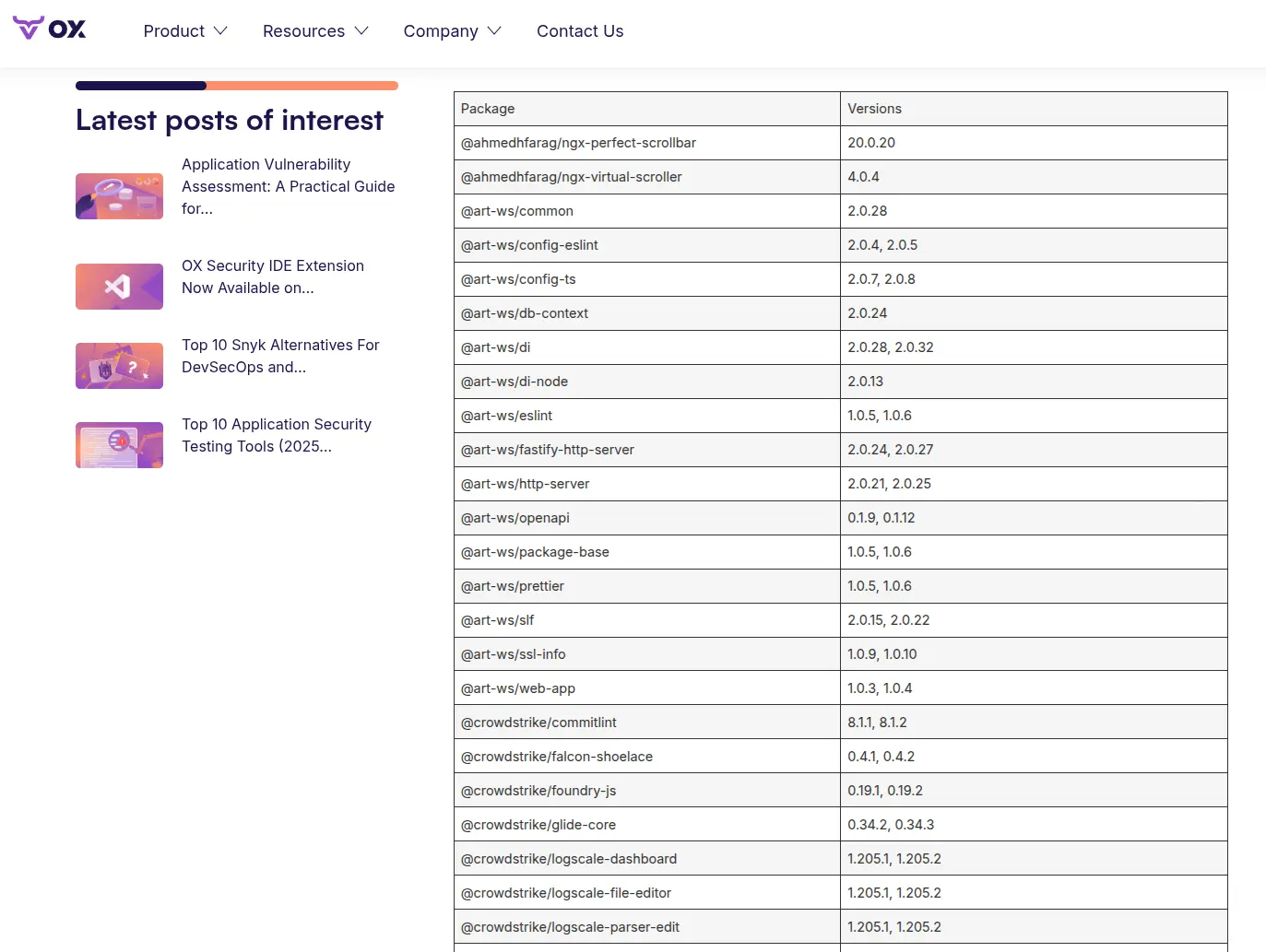 Major packages compromised in the Shai-Hulud attack include @ctrl/tinycolor, @crowdstrike/falcon-shoelace, ngx-bootstrap, and 180+ others. The attack targeted popular libraries across multiple maintainers, from UI components to security tools, demonstrating the massive scope of this supply chain breach. Source: OX Security
The attack started with a humble, deprecated package called rxnt-authentication that hadn’t seen updates in ages. Then suddenly—plot twist!—versions 0.0.5 and 0.0.6 appeared like digital ghosts, carrying their malicious payload into the wild.
The Anatomy of Digital Darwinism
Here’s where it gets technically fascinating (and terrifying):
Step 1: The Phishing Hook Some poor developer probably got a convincing email: “Hey, you need to update your npm token for security reasons! Click here!” Click. Game over.
Step 2: The Trojan Horse The attackers push malicious versions using patch updates (because apparently we still haven’t learned not to auto-upgrade patch versions—seriously, people, LOCK YOUR VERSIONS).
Step 3: The Digital Parasite Once installed, the package runs a post-install script that deploys something called “Truffle Hog”—which, sidebar, is both an excellent name and a legitimate security tool that scans for leaked credentials. Except now it’s being used for evil instead of good. It’s like watching Superman turn into a bank robber.
Step 4: The Viral Spread Here’s the masterpiece: Instead of just exfiltrating your tokens to some remote server, Shai-Hulud immediately gets to work on your GitHub repositories. It:
- Updates your CI/CD pipelines
- Modifies your package.json files
- Publishes new “patch” versions of your packages
- Includes itself in the new versions
Rinse, repeat, exponential growth. It’s like a pyramid scheme, but for malware.
The Numbers Game (Spoiler: We’re Losing)
The attack started with 40 compromised packages. Within hours, that number jumped to 180+. At this growth rate, by next week we’ll have more infected packages than there are atoms in the observable universe. (Okay, that’s hyperbole, but the exponential growth is genuinely terrifying.)
But wait—there’s more! Among the victims, we have the crown jewel of irony: CrowdStrike!
Yes, you read that right. The same CrowdStrike that sells security solutions and gave us the great blue screen of death incident earlier this year is now—drumroll please—accidentally distributing worm attacks through their npm packages. Specifically, the attack compromised:
@crowdstrike/commitlint(versions 8.1.1, 8.1.2)@crowdstrike/falcon-shoelace(versions 0.4.1, 0.4.2)@crowdstrike/foundry-js(versions 0.19.1, 0.19.2)@crowdstrike/glide-core(versions 0.34.2, 0.34.3)@crowdstrike/logscale-dashboard(versions 1.205.1, 1.205.2)@crowdstrike/tailwind-toucan-base(versions 5.0.1, 5.0.2)
You literally cannot make this stuff up. The universe has a sense of humor, and that sense of humor is apparently very, very dark.
The “Tiny Color” Tragedy
Another victim worth mentioning is the popular tiny-color package, which got hit through its maintainer’s compromised credentials. Versions 4.11 and 4.12 were infected, but in a beautiful act of defiant humor, the safe version was released as… 4.20.
Chef’s kiss to whoever made that version number decision. In the midst of chaos, someone still had time for a joke.
The Dependency Hell We’ve Created
This attack highlights something we’ve been willfully ignoring: our dependency trees are insane. We’re importing entire libraries to use single functions. Need to pad a string? Import left-pad. Need to check if something is a number? Import is-number. Need to convert HSV to RGB? Import yet another package with 47 transitive dependencies.
In the age of AI, where you can literally ask ChatGPT “write me a left-pad function” and get a working implementation in 3 seconds, why are we still playing dependency Russian roulette?
The Auto-Update Addiction
Can we talk about auto-updating patch versions? STOP IT. Just… stop. This is like the third major attack this year that relied on automatic patch version updates. It’s 2025, and we’re still making the same mistake over and over.
Lock your versions. Yes, it’s more work. Yes, you’ll miss some bug fixes. But you know what you won’t miss? Accidentally installing self-replicating malware.
Here’s the thing: even if you’re a good citizen and lock your versions, you’re still vulnerable because package managers are recursive nightmares. You depend on package A, which depends on package B, which auto-updates to include malware, which then infects your project anyway.
It’s dependencies all the way down, and every level is a potential attack vector.
The Real-World Impact
This isn’t just theoretical. Real companies, real projects, real production environments got hit. The attack targeted:
- Development environments with exposed GitHub tokens
- CI/CD pipelines with publishing credentials
- Local developer machines with cached authentication
If you had npm tokens lying around anywhere—in your environment variables, your CI config, your browser’s saved passwords—Shai-Hulud was coming for them.
Defense Strategies (Or: How Not to Get Pwned)
1. Lock Everything Down
{
  "dependencies": {
    "some-package": "1.2.3",  // Exact version, no tildes, no carets
    "another-package": "4.5.6"
  }
}
2. Audit Like Your Life Depends On It
Run npm audit religiously. Set up automated dependency scanning. Treat your package.json like it contains nuclear launch codes.
3. Minimize Dependencies Ask yourself: “Do I really need a package to check if a number is odd?” The answer is probably no.
4. Rotate Your Tokens If you haven’t rotated your npm tokens recently, do it now. If you have tokens from 2019 still floating around, delete them yesterday.
5. Monitor Your Packages If you maintain packages, set up alerts for unexpected publishes. If version 3.1.4 suddenly appears and you didn’t publish it, that’s a red flag the size of Texas.
The Bigger Picture
Shai-Hulud represents an evolution in supply chain attacks. It’s not just malware—it’s self-propagating malware. It’s what happens when attackers study network effects and apply them to cybercrime.
This attack succeeded because it exploited several systemic issues:
- Over-reliance on automated dependency updates
- Poor token hygiene across the ecosystem
- The interconnected nature of modern package management
- Developers’ tendency to trust patch updates implicitly
What This Means for the Future
We’re at an inflection point. Either we collectively get serious about supply chain security, or we’re going to see more attacks like this. Shai-Hulud proved that npm’s ecosystem can be weaponized into a distributed attack platform.
The next attack might be worse. It might target Docker images, or Python packages, or Rust crates. It might persist longer, spread faster, or cause more damage.
The Silver Lining
There is some good news: This attack was caught relatively quickly, the affected packages are being cleaned up, and the security community is responding rapidly with better detection tools and practices.
Also, we’re all getting a crash course in supply chain security whether we wanted it or not. Nothing teaches defensive programming quite like watching your entire ecosystem get owned by a self-replicating package virus.
Lessons Learned (The Hard Way)
- Auto-updates are convenient until they’re catastrophic
- Every dependency is a potential attack vector
- Token rotation isn’t optional—it’s essential
- The cost of writing your own utility functions is now lower than the risk of importing them
- Security isn’t someone else’s problem—it’s everyone’s problem
Final Thoughts
As I write this, the Shai-Hulud cleanup is ongoing. Packages are being patched, tokens are being rotated, and developers everywhere are having uncomfortable conversations about their dependency management practices.
The attack was brilliant in its simplicity and terrifying in its effectiveness. It turned npm’s greatest strength—its interconnected ecosystem—into its greatest vulnerability.
But here’s the thing: we can learn from this. We can build better tools, implement better practices, and create more resilient systems. Or we can ignore the lessons and wait for Shai-Hulud 2.0.
The choice is ours. Let’s make it a good one.
Stay vigilant, keep your dependencies locked, and remember: in the world of package management, paranoia isn’t a bug—it’s a feature.
Resources:
- Palo Alto Networks: NPM Supply Chain Attack Analysis
- OX Security: NPM 2.0 Hack Details
- The Hacker News: 40+ NPM Packages Compromised
Update your packages responsibly, friends. The ecosystem depends on it.