

Picture this: You’re building the world’s most advanced skyscraper. You’ve got state-of-the-art materials, brilliant architects, and unlimited funding. But here’s the catch—the entire billion-dollar structure rests on a single wooden block, hand-carved by some random dude you never met living in Nebraska and maintains it as a hobby between fishing trips.
Welcome to modern software development, where this isn’t a hypothetical nightmare—it’s Friday.
The Comic That Made Developers Sweat
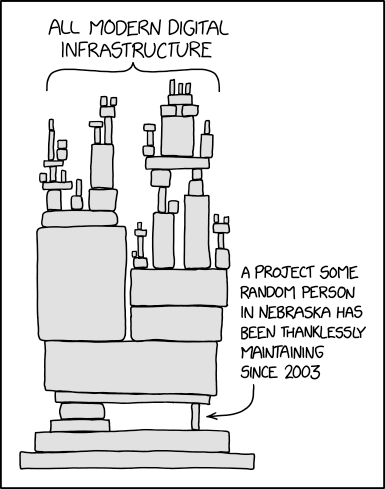
Randall Munroe’s xkcd #2347 hit the programming world like a perfectly targeted precision strike. The comic shows a precarious tower of blocks labeled “All modern digital infrastructure” balanced impossibly on a single tiny block: “A project some random person in Nebraska has been thanklessly maintaining since 2003.”
If you’re not a programmer, you might think this is an exaggeration. If you are a programmer, you’re probably checking your LinkedIn profile to make sure you don’t accidentally list Nebraska as your location.
The Magnificent Absurdity of It All
Here’s what makes this both hilarious and terrifying: it’s completely accurate.
The internet—that marvel of human engineering that lets you video chat with your grandmother while simultaneously ordering sushi and arguing about movie plots—depends on thousands of tiny software libraries. Many of these are maintained by individuals who:
- Have day jobs completely unrelated to their world-critical code
- Started the project to solve their own specific problem
- Never intended for millions of apps to depend on their work
- Receive approximately zero dollars for keeping civilization running
It’s like discovering that the Golden Gate Bridge’s main support cable is actually a really good friendship bracelet made by someone’s cousin, and somehow it’s been working fine for decades.
When the Tower Wobbles
The comic isn’t just funny—it’s prophetic. We’ve seen this exact scenario play out in real life:
The Left-Pad Apocalypse of 2016: A developer removed an 11-line JavaScript library from the internet. Suddenly, major websites couldn’t build their code. Eleven lines. Eleven. That’s shorter than most grocery lists, and it nearly broke the internet for a day.
The Great OpenSSL Scare: The library that secures much of internet communication was, for years, maintained by a handful of volunteers working in their spare time. As one headline put it: “The Internet is Being Protected by Two Guys Named Steve.”
The Core-js Chronicles: A library used by 75% of the top 100 websites was maintained by one person who quit his job to work on it full-time, couldn’t afford to live, got into legal trouble, and went to prison. Meanwhile, most of the internet kept using his code without knowing his name.
The Beautiful Madness of Open Source
What makes this whole situation both absurd and oddly inspiring is that it somehow works. This anarchic system of digital communism—where neither capitalism nor government funding drives development—keeps our technological world spinning.
Think about it: No one is paying these people. No government mandated their work. No corporation owns most of these critical pieces. Yet somehow, through pure voluntary effort and what can only be described as digital altruism, we have this incredible shared infrastructure.
It’s like if all the world’s roads were built and maintained by people who just thought, “You know what? I like roads. I’ll fix this one in my spare time.” And somehow this resulted in a perfectly functional global transportation system.
The Nebraska Factor
Why Nebraska, you ask? It’s the perfect metaphor for “middle of nowhere”—no offense to Nebraskans, who probably have better things to do than maintain critical internet infrastructure (but apparently do it anyway).
The genius of the comic is that it captures the geographic and social anonymity of these maintainers. Somewhere, right now, someone is fixing a bug in a library that your bank’s app depends on, and they’re probably doing it while watching Netflix in their pajamas.
The Plot Twist: It’s Getting Worse
Here’s where the comedy turns slightly darker. The dependency problem is actually getting more complex:
- More dependencies than ever: Modern apps can depend on thousands of external libraries
- Deeper nesting: Libraries depend on other libraries, which depend on other libraries
- Faster churn: The “random person in Nebraska” might abandon the project next month for a new job
We’re essentially playing Jenga with the entire digital world, and every year we add more blocks to an increasingly unstable tower.
The Security Nightmare
The recent xz backdoor incident added a terrifying new dimension to this comic. A malicious actor spent three years building trust with a maintainer, eventually taking over the project and inserting a backdoor that could have compromised systems worldwide. The only reason we avoided catastrophe was because one person noticed their SSH login was using slightly more CPU than usual.
One person. Slightly more CPU. That was the thin line between normal Friday and “the day the internet fell over.”
The Unsung Heroes
Despite the precarious situation, we should celebrate these anonymous maintainers. They’re not just keeping the lights on—they’re making modern software development possible. Without them, every programmer would need to reinvent every wheel, and we’d still be writing calculators from scratch.
These are people who:
- Fix bugs at 2 AM because someone on the other side of the world filed an issue
- Write documentation that’s better than most paid software
- Handle feature requests from million-dollar companies with patience and professionalism
- Do it all for free, out of love for good code and functional systems
The Lesson Hidden in the Laughter
The xkcd comic is funny because it reveals an uncomfortable truth: our sophisticated technological world is built on a foundation of voluntary human kindness. The “random person in Nebraska” isn’t a weakness in the system—they’re proof that the system, somehow, actually works.
Sure, it’s precarious. Yes, it could all come tumbling down if the wrong person decides to take up pottery instead of programming. But the fact that it works at all is a testament to human cooperation and the strange magic of open source development.
What Can We Do?
If this comic made you nervous about your app’s dependencies (it should), here are some thoughts:
- Know your dependencies: Understand what your software relies on
- Support maintainers: Many accept donations or corporate sponsorship
- Contribute back: File good bug reports, write documentation, submit patches
- Have backup plans: For truly critical dependencies, consider alternatives
The Magnificent, Terrifying Future
As we build increasingly complex systems on this foundation of digital goodwill, the Nebraska person becomes both more important and more anonymous. We depend on them more than ever, yet most of us don’t even know their names.
It’s a setup that would be completely absurd if it weren’t completely real. Somewhere right now, someone is maintaining the code that keeps your morning alarm working, your coffee shop’s payment system running, and your streaming service delivering just the right show to help you fall asleep.
And they’re probably doing it for free, because they think the code should work properly.
The random person in Nebraska isn’t a bug in our system—they’re a feature. A beautiful, precarious, absolutely essential feature that makes our digital world possible.
So the next time your app works perfectly, maybe send a small thanks to the universe for all the anonymous heroes keeping the great digital Jenga tower standing.
Just try not to think too hard about what happens when they decide to take a vacation.
Original comic: xkcd #2347: Dependency
Read more: Check out the comprehensive explanation of this comic for real-world examples and deeper technical context.